

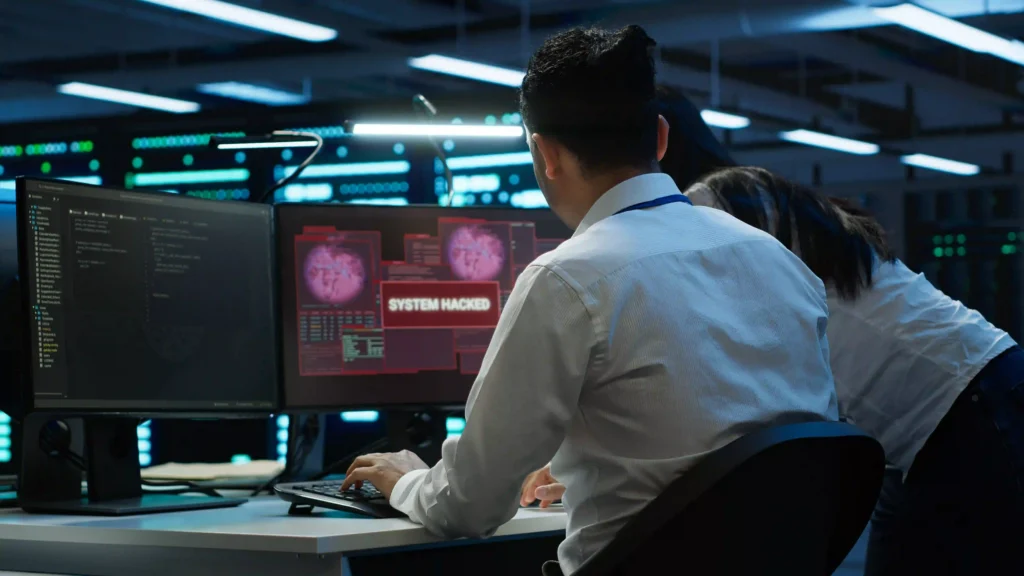
How a Cyber Security Consultant Defeats AI Threats
Introduction
In 2026, the digital battlefield has undergone a radical transformation. Threat actors have moved beyond using Artificial Intelligence as a simple productivity tool; they now deploy autonomous “agentic” AI hacking agents. These entities can scan for weaknesses, exploit vulnerabilities, and adapt their tactics at machine speed, making traditional manual defences obsolete. As these attacks become faster and harder to recognise, the modern cyber security consultant has shifted from being a reactive “firefighter” to an architect of intelligent resilience.
This is where ACEiT Group makes the difference through their advanced ACE IT service, designed to build real-world readiness by combining modern controls with identity governance and AI-driven detection. Rather than merely reacting to breaches, we shape your digital infrastructure with intentional pacing and seamless transitions into a more secure state. By partnering with a specialist cyber security consultant, organisations can ensure they operate confidently even under the pressure of continuous, evolving threats.
1. Implementing Agentic Defence: AI vs. AI
The only practical way to stop machine-speed attacks is with machine-speed defence. This is why a cyber security consultant increasingly deploys agentic defence models. In this framework, defensive AI agents act as the first responders within a modern Cybersecurity Operations Centre.
The rise in AI-powered deception is a growing concern in Malaysia, as evidenced by local banks and enterprises navigating increasingly complex digital risks. As a cyber security consultant would observe, the automation of threats requires an equally automated response.
The strategy involves:
Automated Containment: Executing actions like isolating compromised endpoints or suspending risky tokens within seconds.
Session Revocation: Immediately revoking sessions and blocking suspicious traffic once malicious behaviour is identified.
Behavioural Baselining: Using AI to learn “normal” user patterns, such as typical API calls and login locations.
Proactive Hunting: Identifying subtle anomalies, such as service accounts making unusual outbound connections.
By reducing the time between detection and response, a cyber security consultant directly limits the business impact of AI-enabled malware. This “AI vs. AI” approach gives human analysts a faster shield, stopping lateral movement before it escalates.
2. Moving to Identity-Centric Zero Trust
With AI now capable of generating hyper-realistic deepfakes and near-perfect phishing content, the traditional network perimeter has effectively dissolved. Today, a cyber security consultant redefines the perimeter as identity and access. Zero Trust in 2026 is no longer just a one-time multi-factor authentication (MFA) check at login; it is a process of continuous verification.
A cyber security consultant focuses on:
Contextual Signals: Verifying device posture, location consistency, and risk scoring in real-time.
Un-human Behaviour Detection: Restricting access automatically if an identity begins accessing systems at speeds impossible for a human.
Non-Human Identity (NHI) Governance: Managing the thousands of service accounts, automation scripts, and AI agents that often outnumber human users.
Least Privilege: Tightening entitlement controls to ensure no account has more power than necessary.
3. Proactive AI Red Teaming
Waiting for a breach is no longer a viable strategy when threats evolve daily. A cyber security consultant now uses AI red teaming to stress-test systems and reveal weaknesses before adversaries do. This involves sophisticated drills like prompt injection testing for organisations using internal Large Language Models (LLMs).
During these tests, the cyber security consultant attempts to manipulate AI assistants to leak sensitive information or bypass security guardrails. They also perform model evasion drills, where subtle input manipulations are used to trick filtering systems into classifying malicious content as safe. The findings from these tests are not just for “proving risk” but are fed back into detection rules and response playbooks to harden the entire organisation.
4. Defeating AI-Enhanced Social Engineering
AI has removed the classic warning signs of fraud, such as poor grammar or awkward phrasing. Modern social engineering is far more convincing, often involving cloned voices or deepfake video calls. To counter this, a cyber security consultant builds multi-channel verification protocols.
These protocols include:
Out-of-band Confirmation: Requiring a second, separate channel to verify any urgent request for money or sensitive data.
Internal Ticketing: Mandatory confirmation through official internal systems for high-risk actions.
Adaptive Simulations: Upgrading staff training from static presentations to AI-aware simulations that mirror current attacker methods.
By turning good judgment into a repeatable business process, a cyber security consultant ensures that the “human element” is no longer the weakest link.
5. Modernising Recovery: Assuming Impact
In 2026, a cyber security consultant works with the philosophy of “assume impact”. This means the recovery plan is built specifically for the moment an AI threat successfully breaks through. Modern recovery begins with immutable or air-gapped backups that cannot be encrypted or deleted by attackers, even those with administrative privileges.
Furthermore, the cyber security consultant implements “kill-switch” playbooks. These allow for the rapid shutdown of compromised accounts across both cloud and on-premise environments simultaneously. By having rehearsed incident workflows, the organisation ensures that recovery is never improvised during a crisis. The ultimate goal for the cyber security consultant is business continuity—ensuring operations return to normal faster and with minimal reputational damage.
Frequently Asked Questions
Traditional antivirus is often insufficient because modern threats use behaviour-based tactics and fileless execution. A cyber security consultant typically recommends XDR and behaviour analytics to detect suspicious actions rather than relying on known signatures.
A major risk is Business Email Compromise "2.0," where AI studies an organisation's writing style and timing to send highly convincing fraudulent requests.
A cyber security consultant reduces deepfake risk by enforcing out-of-band verification and creating escalation rules for urgent financial or access requests.
The fastest steps involve improving identity governance, ensuring central logging across cloud and endpoints, and validating recovery playbooks.
Success is measured through metrics like reduced mean time to detect (MTTD) and contain, as well as reduced downtime through stronger recovery readiness.
Conclusion
Defeating AI threats in 2026 requires a strategic shift toward autonomous defence, identity-centric governance, and proactive testing. A professional cyber security consultant brings these elements together to ensure that an incident does not become a business-ending disruption.
To learn more about our team and mission, you can visit our About Us page. If you are ready to harden your defences, the ACEiT Group is here to help you stay one step ahead of machine-speed threats. For a tailored strategy or to discuss your specific risks, please Contact Us today. By deploying AI-driven detection and modernising your recovery workflows, you can maintain the confidence to innovate and grow in an AI-driven world.